You drove out. You measured. You figured it. You wrote it up. Then the customer went quiet, and you let it go. That one hurts the most, because you already did the work.
Last updated: October 2026 · By Gen X Still Standing
Follow up. Most people who go quiet on an estimate aren't saying no. They're busy. They're waiting on a spouse. They got two other bids and haven't looked yet.
A polite, useful follow-up isn't pushy. It's the guy who shows up.
In one field-software company's survey (Rivetops, one vendor's numbers, so treat them as a rough guide), almost half of contractors said they never follow up on an estimate. The few who follow up five or more times close far more.
Speed counts too. A Harvard Business Review study of web leads (2011) found companies that responded within an hour were about 7 times more likely to reach a decision-maker than ones that waited 24 hours or more. Speed is the one advantage a one-man shop can have over a big outfit.
Every follow-up gives the customer a reason to answer. Never "just checking in."
Pull up the last three estimates you sent that went quiet. Write the names down. Next to each one, write what you quoted, the day you sent it, and anything they said: worried about price, waiting on a spouse, getting other bids.
That's what a good follow-up gets written around. A message built on the real reason they went quiet reads like the guy who listened, not the guy who wants his money.
Three is easy to keep track of. Thirty isn't. If estimates go quiet faster than you can remember to chase them, that's not a character flaw. That's an office with nobody in it.
I learned the trades hands-on and ran my own construction company in Colorado. I had to close my company down and start over from zero. So at 53, off YouTube videos, I taught myself AI. I wasn't a tech guy. You don't need to be one either.
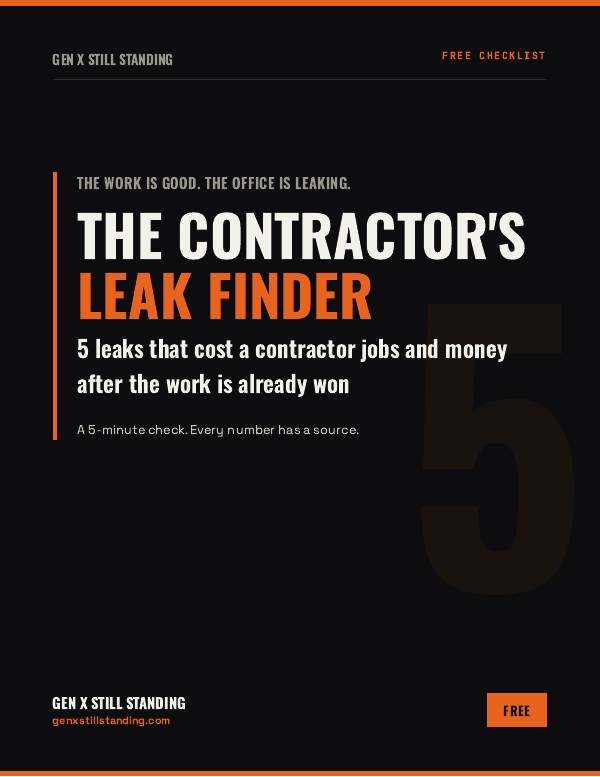
The free Contractor's Leak Finder: slow callbacks, quiet estimates, free extra work, late invoices and missing reviews. What each one costs, a score that tells you how bad it is, and where the numbers come from.
Free. You'll also get the weekly newsletter. Unsubscribe anytime. Privacy Policy.
Should I follow up on an estimate?
Yes. Most people who go quiet aren't saying no. They're busy, waiting on a spouse, or haven't looked at the other bids yet.
How do I follow up without being pushy?
Give the customer a reason to answer every time. Never open with "just checking in." No guilt, no pressure, no fake deadlines.
Do contractors really skip follow-up?
In one field-software company's survey (Rivetops, one vendor's numbers), almost half of contractors said they never follow up on an estimate.
How fast should I get back to a new lead?
Fast. A Harvard Business Review study of web leads (2011) found companies that responded within an hour were about 7 times more likely to reach a decision-maker than ones that waited 24 hours or more.
Should I offer a discount to close it?
Only if you decided to. A good follow-up doesn't throw in a discount you didn't approve.
Educational only. Not legal advice. Contract, lien and collection rules vary by state. You're responsible for reviewing anything AI produces. Results vary and are not guaranteed. Built by a Gen Xer with AI, for Gen Xers.